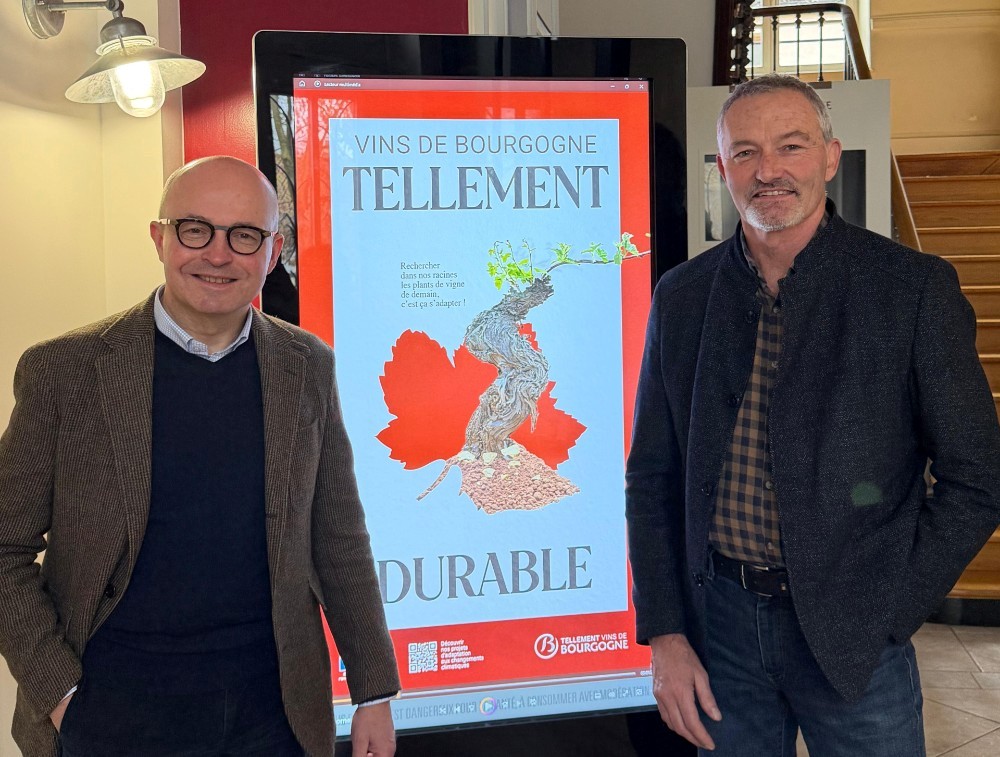
Photo: @BIVB
At its General Assembly last week, the Bourgogne Wine Board elected a new Permanent Committee, led by two Co-Presidents: Laurent Delaunay, representing the “négoce family”, and Michel Barraud, who succeeds François Labet as representative of the winegrowing sector. Elected for a four-year term, they will jointly lead the development of the sector’s 2035 strategic plan, scheduled for approval in early July.
Efficiency, Unity, and Ambition to Prepare Bourgogne for the Future
Before the appointment of the new Permanent Committee, François Labet and Laurent Delaunay, who have served as Co-Presidents since 2022, presented an overview of the current state of the Bourgogne wine sector.
Delaunay set the tone from the outset, framing his remarks around what he described as a year of transition and collective reflection. He emphasized the need for the sector to take a clear-eyed look at the role, responsibilities, and resources of its interprofessional body in order to respond effectively to an increasingly complex set of challenges.
He went on to outline a difficult global context for wine, marked by the combined effects of climate change, economic uncertainty and persistent inflation in many markets, geopolitical tensions, increasing disruption to international trade, and the growing stigmatization of wine consumption in France and abroad.
Societal expectations and unfavorable demographic trends, he noted, further compound these pressures.
Against this backdrop, Delaunay acknowledged that while Bourgogne wines continue to occupy a distinctive position, current indicators call for caution rather than complacency.
As he put it: “The first half of 2026 will be devoted to the collective drafting of our new ten-year strategic plan.”
He expressed the hope that, over the coming four years, this strategy will focus squarely on efficiency in the service of the entire sector.
These issues were also central to the recent “Vinosphère” forum, which marked the launch of the co-construction process for the 2035 strategy. The plan is scheduled to be submitted to a vote at the General Assembly on July 1.
Laurent Delaunay concluded with a call to mobilize around Bourgogne’s enduring strengths, underscoring the region’s international reputation for terroir-driven viticulture and the shared responsibility to sustain its high standards and long-term ambition.
Newly elected as President for the winegrowing sector, Michel Barraud opened his remarks with a clear call for unity—both within the interprofessional body itself and across the Bourgogne region as a whole, from north to south. He emphasized his intention to act as a unifying force throughout his term.
In light of the challenges currently facing the sector, Michel Barraud reaffirmed the central role of the Bourgogne Wine Board’s three strategic pillars of action.
– The Technical and Innovation division, he noted, will be tasked with supporting the sector in responding to climate change and recurring harvest losses, while safeguarding Bourgogne’s standards of quality and excellence.
– The Economic and Strategic Intelligence division will play a key steering role in shaping the long-term vision, notably through the forward-looking market study launched at the end of 2025, designed to inform strategic decision-making toward the 2035 horizon.
– The Marketing and Communication division also remains a priority. Michel Barraud stressed the importance of continuing to train key prescribers, while at the same time strengthening direct ties with consumers—particularly through the further development of wine tourism. In this context, he highlighted the growing importance of visitor engagement at the Cités des Climats et vins de Bourgogne network, welcoming the recent appointment of Édouard Mognetti to lead the structure that now encompasses the entire vineyard.
Carbon neutrality, which forms the foundation of the 2035 strategy, will serve both as the driving force and the underlying framework of the forthcoming ten-year plan. Michel Barraud concluded by invoking a reflection from Antoine de Saint-Exupéry, which he said encapsulated the spirit of the mandate ahead: “The future is nothing more than the present put in order. You do not have to foresee it—you have to enable it.”