Argea publishes its 2025 Sustainability Report:
supply chain, decarbonisation and ecodesign at the heart of the Group’s strategy
From the Supply Chain Pact to emissions reduction targets: Italy’s leading private wine group reports tangible progress across its value chain
Milan, May 2026 – Argea presents its new 2025 Sustainability Report – Habitat, the document that reports on the progress of the Group’s ESG journey across four pillars – Direction, Supply Chain, Land and Talent – and reaffirms the integration of sustainability into its business strategy.
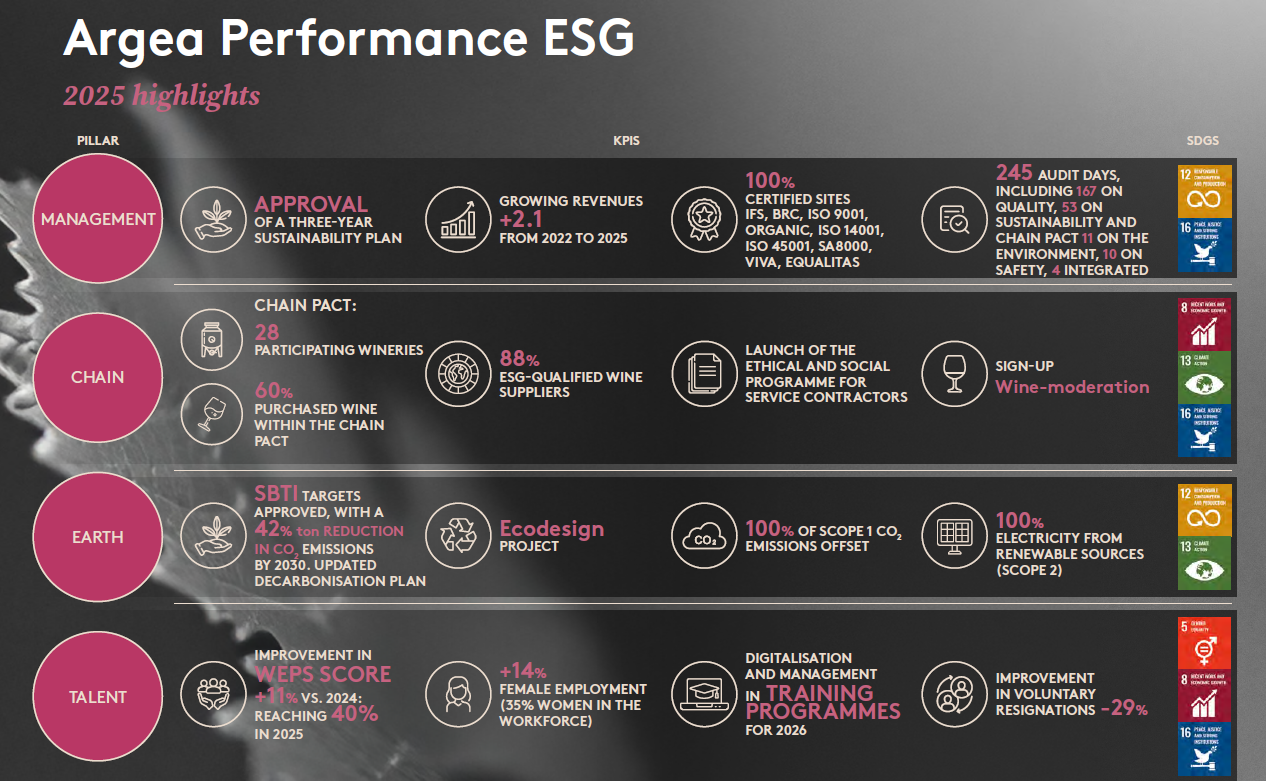
>In 2025, the Group strengthened its work across the supply chain: the Argea Wine Supply Chain Sustainability Pact now covers 60.5% of wine sourced from external suppliers, involving 28 wineries and 424 hours of audits. In addition, 88% of wine suppliers successfully completed the ESG qualification process, which assesses environmental, social and governance criteria.
>The Report also highlights progress in resource management: 100% of electricity from renewable sources, a reduction of more than 20% in waste generation, 89.3% of waste sent for recycling, and net water consumption reduced by approximately 24%.
>On the climate front, total emissions decreased by around 2.6% compared to 2024. Argea also obtained approval of its targets from the Science Based Targets initiative, committing to reduce emissions generated by business operations, purchased energy and the supply chain by 42% by 2030, and a Net-Zero target for 2050.
>Among the Group’s product-related initiatives, one of the most representative is Gualdo Romagna DOC Sangiovese Predappio Biosimbiotico by Poderi dal Nespoli – a practical example of biosymbiotic agriculture combined with ecodesign principles.
>100% of Argea sites are now certified according to international standards for quality, occupational health and safety, environment, food safety and sustainability.
From a social perspective, voluntary turnover fell to 5.2%, women now represent 34.7% of the workforce, and the WEPs score on gender equality increased from 36% to 40%.
“In a particularly complex context for the wine industry, marked by declining consumption, rising cost pressure, evolving consumption styles and growing attention to environmental impacts, Argea is consolidating its development model with data that relate not only to production sites, but to the entire value chain: vineyards, supplying wineries, suppliers, packaging, logistics, people and communities,” says Massimo Romani, CEO of Argea. “For Argea, sustainability means taking responsibility for the impact we generate and turning it into long-term positive value. With this objective, we have continued to reinforce our approach, keeping sustainability as a central axis of the Group’s industrial and strategic decisions. This Report is not a finishing point, but another step in an ongoing journey.”
A sustainability model for Italian wine
With Habitat 2025, Argea strengthens its positioning as an Italian wine group capable of combining industrial scale, strong territorial roots and increasingly rigorous impact measurement.
The Report outlines a model in which sustainability is not treated as a separate area from the business, but rather as an operational criterion running across the supply chain, production, packaging, markets, people and governance. An approach that views wine not simply as a product, but as a system of relationships between agriculture, enterprise, communities and shared responsibility.
“Talking about sustainability means making the traces of the way we do business legible: turning commitment into evidence, choices into results, principles into verifiable practices,” comments Michael Isnardi, Group QHSE & Sustainability Director at Argea. “In 2025, we worked to strengthen ESG governance, improve data quality, advance supplier qualification, pursue decarbonisation, and develop pilot projects capable of generating knowledge for the entire Group.”