
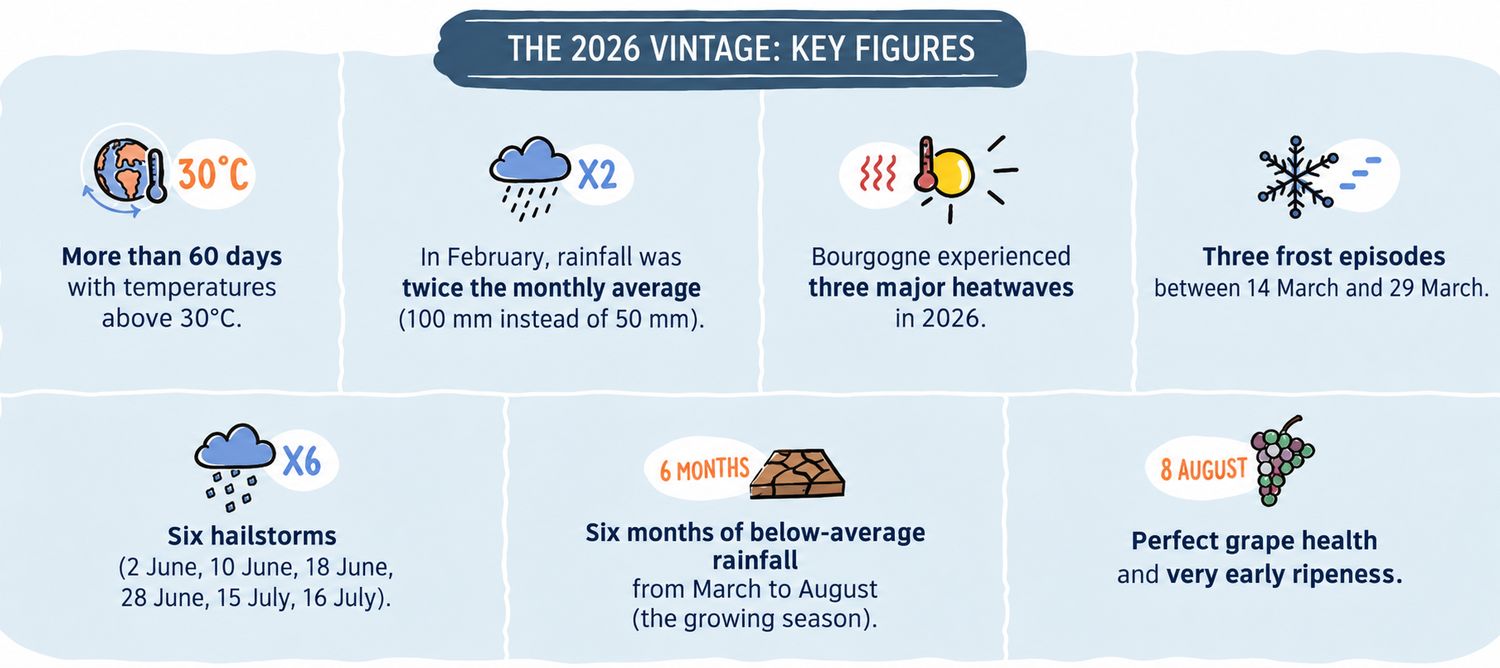
The year 2026 will go down in the history of Bourgogne. 2026 is the earliest vintage ever recorded in Bourgogne. Harvesting began as early as 8 August in the Mâconnais for Crémant de Bourgogne, following unprecedented weather conditions (see above).
Although heat and drought have reduced yields, quality looks promising. Initial tastings reveal wines of remarkable aromatic purity, bursting with flavour and already displaying a fine balance.
White wines
The white wines stand out for their roundness and suppleness. Their aromas are clear-cut and complex, with yellow-fruit notes of pear and peach. In some areas, exotic hints of mango or pineapple emerge.
On the palate, fresh-fruit flavours and fine balance preserve a welcome freshness.
Already expressive, these wines should be enjoyable in their youth.
Red wines
Winegrowers across the region agree: the reds are magnificent. They combine intensity and aromatic richness with harmonious structure and beautifully maintained balance.
The excellent ripeness of the grape skins contributed to the wines’ deep, intense colour right from the start.
The aromatic profiles, sometimes spicy, evoke dark fruits (blackcurrant, blackberry, blueberry, black cherry and fresh fig), without veering into cooked-fruit notes, as the summer heat might have led us to fear.
On the palate, lively acidity and fully ripe tannins underpin harmonious structure and excellent balance.
Crémant de Bourgogne
The 2026 vintage offers generous, expressive and well-structured potential. Despite high levels of ripeness, acidity has preserved a welcome freshness in the base wines. Their profile combines length on the palate with ample structure.
Nevertheless, the distinctive character of this vintage calls for particular expertise to achieve the right balance and turn this natural richness into sparkling wines of precision and elegance. Reserve wines from 2024 and 2025 could prove valuable in adding complexity and freshness, while reinforcing the consistency and identity of future blends.