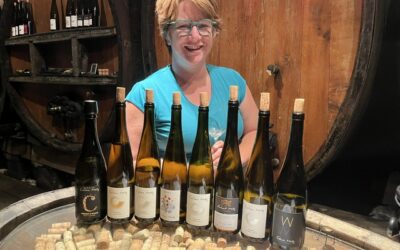

Glasses at a wine tasting © Austrian Wine / Martin Grabmayer
Accelerated ripening and reduced volumes due to heat and drought
Premature budding, early flowering and high temperatures significantly accelerated grape ripening in 2026. As a result, harvesting also began early this year. At the same time, drought led to considerably reduced yields with a harvest of around 1.7 million hectolitres expected. However, the small, ripe and healthy grapes bode well for quality.
“In many respects, 2026 is an exceptional vintage with early ripening, small berries and low harvest volumes. At the same time, winegrowers are bringing in very healthy, ripe grapes this year. We’re expecting an expressive and aromatic vintage,” said Johannes Schmuckenschlager, President of Austria’s Winegrowers Association, at the annual harvest press briefing in Vienna.
A low harvest volume
In terms of volume, the 2026 harvest is expected to be significantly lower than both last year’s harvest and the average of recent years. “According to current information from the winegrowing regions, we’re expecting this year’s harvest to be around 1.7 million hectolitres. That’s over 30 percent less than the previous year’s harvest,” Schmuckenschlager pointed out. “The extreme drought conditions have clearly left their mark. Many of the berries are very small and this also brings with it a lower must yield.”
Small berries, intensive aromatics
Although the drought has reduced the harvest volume, the quality of the vintage is expected to be good. The low risk of disease means that the grapes harvested are consistently healthy. Harvesting at the right time is one of the most critical factors this year. “Ripening is already well advanced due to the weather conditions, so winegrowers need to begin harvesting early to ensure a harmonious sugar-to-acid ratio,” explained Schmuckenschlager. One of the main characteristics of this vintage is the small size of the berries. “Small berries mean less juice, but a higher concentration of valuable compounds. That’s why we’re expecting particularly aromatic and expressive wines,” explained Schmuckenschlager. The president of the Winegrowers’ Association is also particularly optimistic about the prospects for red wines. “The small, darkly coloured and concentrated red-wine grapes point to dense, fully ripe wines.”
The 2026 vintage characterised by drought and heat
Weather conditions in 2026 were the main reason for the exceptionally early harvest. The winter months were marked by precipitation and several periods of frost, but from late April onwards, temperatures were almost summery. The vines started budding in mid-April. Despite this, there were virtually no reports of damage due to late frosts. The warm weather accelerated further growth, with flowering beginning as early as the end of May or the beginning of June.
By early June, many places were reporting a lack of rainfall and by the middle of the month, the first major heatwave had set in, which resulted in the vines putting on a growth spurt. Apart from isolated thunderstorms, the winegrowing regions saw no significant rainfall. Eastern Austria was particularly affected by extreme drought and heat. Long periods with temperatures above 30°C were the norm this summer.
As grapevines are perennial crops with deep root systems, they are less susceptible to drought than other agricultural crops. However, this year’s drought even managed to push grapevines to the limits of their vegetative growth. Young vineyards, whose vines have not yet had the chance to develop strong root systems, were particularly affected. In some cases, grapes were removed to reduce the strain on the young plants. The extent of drought damage in individual vineyards was largely determined by the properties of the soils and their water storage capacity, as well as management and care of the vines during the dry periods.
Main harvest started at the beginning of September
The premature budding, early flowering and the high temperatures during the summer significantly accelerated grape ripening. As a result, harvesting also began early. In the Seewinkel region of Burgenland, the harvest is already nearing completion. In Niederösterreich (Lower Austria), Steiermark (Styria) and Wien (Vienna), the main harvest began in early September.
Austrian quality as a competitive advantage – despite challenging market conditions
Alongside lower yields due to weather conditions, wine producers continue to face a challenging market environment. Declining wine consumption due to changing consumer behaviour, coupled with intense price pressure, is affecting the entire industry. Austria’s winegrowers have a structural advantage here that they can capitalise on. Their wines are not only fresh, artisan-made and high quality, but also produced in an environmentally responsible manner. This provides a strong foundation for Austrian winegrowers to remain competitive in a shrinking market, respond to consumer trends and strategically expand exports.